
Case Examples: Silver Diamine Fluoride
Silver diamine fluoride has been used to arrest caries since it emerged in Japan in the 1960s. It has regained popularity in Australia over recent years, particularly in paediatric dentistry, providing practitioners and families with an option to slow or halt caries progression
We have been using SDF in our practice for many years, and its applications are numerous:
Early childhood caries when finances and/or behaviour management mean that restorative treatment cannot be carried out in the near future - or, in some cases, at all
To arrest interproximal and smooth-surface caries in the hope of avoiding restorative treatment (THIS IS THE MOST COMMON REASON WE USE IT)
To arrest small carious lesions prior to atraumatic restoration (SMART technique)
To desensitise hypomineralised first molars prior to restorative work or to just allow more normal function.
Our typical protocol is as follows:
For early childhood caries
Thorough clinical and radiographic examination, and a consent process with parents (emphasising that the caries will stain black - show photo examples). Interprox use, does not stain terribly black
Initial application of SDF. We use Topamine SDF, which you can buy here. Silver Diamine Fluoride - 5mL Topamine SDF – The Paediatric Dental Company We apply it for 1min and then wash it off
Reapplication of SDF 1 month later. You require biannual application in the first year.
Four months after the initial application: clinical and radiographic examination (no SDF at this visit); assess treatment efficacy; and discuss the plan moving forward with parents (monitoring only, or a timeframe for restorative treatment).
For incipient lesions
Thorough clinical and radiographic examination, and a consent process
Initial application of SDF. We use Topamine SDF, which you can buy here. Silver Diamine Fluoride - 5mL Topamine SDF – The Paediatric Dental Company We apply it for 1min and then wash it off
Depending on risk factors, review at 4-6 months with repeat radiographs. This is very important. We explain to parents that SDF has a 70-80% success rate for arresting caries with good home care, but that 20-30% of lesions will progress and require treatment. Within this timeframe, it is likely that progression will still be identified early, when simple options such as Hall crowns remain appropriate. If the radiographs appear stable, reapply SDF.
Continue normal recalls, continually assessing risk and reapplying SDF at intervals appropriate to the child.
I would like to show a few cases where SDF has worked wonders, as well as a few that fall into the 20-30% progression category. These highlight the importance of regular reviews and managing patient and parent expectations from the outset.
Case 1
·Initially seen in 2022 at age 2. ECC affecting 53, 52, 51 and 61. Asymptomatic, with no apical pathology.
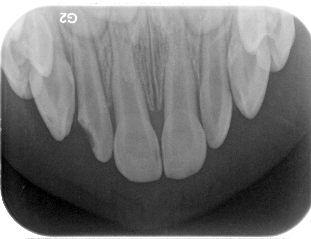
You can see the heavily decayed 52, with healthy dentine to the pulp, Also, a lesions on 51M as well.

8 month review x-ray
Initial SDF application, then reapplication 1 month later
Eight months later (ideally four months, but recall was delayed), radiographic review showed no pathology, some minor enamel breakdown and reparative dentine evident.
The patient remained asymptomatic.
The family were not concerned by aesthetics and had no plans to restore.
The patient was placed on a six-month recall. SDF reapplied. OHI reinforced, as plaque was retained in cavitations.
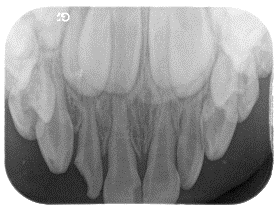
Two years after initial application: further progress to breakdown on 51. SDF reapplied. The affected tooth was hard and black.
It is important to note, the reason 51 progressed and 52 did not is plaque control! That is the number one determinant of success!

Three years after initial application
Asymptomatic, with no concern about aesthetics.
The patient was now at an age and level of compliance where treatment or extraction could be undertaken in the chair if required.
The slow progression had allowed reparative dentine to be laid down, protecting the pulp.
Now that the enamel has broken as well, it is easier to clean, which has assisted the arrest process.
This approach has allowed the family to treat the caries and avoid the need for a GA, which they could not afford.
Case 2
A 5-year-old was seen in 2025. Bitewings showed incipient lesions in deciduous molars, with particular concern for 74 and 84. Options were discussed with the mother:
o SDF with review at 4-month to assess for progression
o Hall crown or composite resin restoration/zirconia crowns
Mum preferred to attempt arrest with SDF and improved home care, including flossing and dietary changes.


Reviewed four months later, all lesions appeared improved from the initial presentation. I had to double-check the dates to ensure I was looking at them in the correct order!
We still need close monitoring and we would repeat the x-rays in around 4-6 months.
CASE 3
4-year-old seen in 2022. Compliance was difficult, but radiographs were taken and SDF applied to incipient interprox lesions on deciduous molars

Case 3

6-month review
Slight progression 84D, no progression to 85M. Reapplied SDF.

Review 18 months after original. 84 progressed enough to warrant hall crown. 85 stable. 54/55 stable..

Almost 3 years after first examination – 54/55, 85 remain stable.
This case highlights the need for ongoing monitoring, and in this case, we were able to string a non-compliant child along before active treatment was required when they were a little older and more compliant when treatment could be done in the chair rather than need a GA for more invasive treatment.
Case 4
A 7-year-old was seen in 2022. Demineralisation was noted on 74D and SDF was applied, with a plan to review in six months.

Baseline

Reviewed after seven months, with significant progression! A Hall crown was no longer an option, and the plan was to undertake a pulpotomy and SSC.
If we had caught this at 4 months, we would have been able to do less invasive treatment.

The patient did not return for treatment; the tooth was subsequently extracted in 2023.
The time between the first and last radiograph was 16 months. This highlights how quickly caries can progress, even in the presence of arresting agents such as SDF. A key component of SDF usage is therefore timely review and ongoing management - it can never be a 'set and forget' modality.
We hope that this has been a bit helpful for some real life examples. We do have a free lecture available where we go into more detail on preventive dental treatment, including SDF. ALL ONLINE COURSES — Kids Dental Tips
We also cover SDF and its application in great detail in our hands on restorative courses! COURSE PRODUCTS — Kids Dental Tips
All the best
Tim, Erica and Sarah