
Orthodontic Considerations in the Paediatric Population - Part 3
This is the last post in our orthidontic series. A sit down with an experienced orthodontist to review some common questions.
Part 1 and 2 are :
Q: Missing 5’s (2nd premolars) – when can we write them off as not coming, and does it affect our decision whether or not to space maintain?
Are there adverse outcomes of removing E’s without a permanent successor too early?
A: Permanent teeth can sometime calcify late: usually the latest tooth bud to calcify is the wisdom teeth and the latest that has been shown to develop is age 14. But 5’s can calcify surprisingly later than expected, especially if there are other dental anomalies present. So don’t write off a premolar as definitely ‘missing’ at a young age!
If the E without a successor is healthy, it is beneficial to leave it there until the child is ready for active orthodontic treatment or has had an orthodontic opinion, as this leaves all orthodontic options open. If space closure is required orthodontically, it is aided by RAP (regional accelerating phenomenon) whereby the healing process post-extraction makes the space closure quicker. Having said this, it is case-dependent and sometimes it can be helpful to extract upper E’s to help alleviate crowding and overjet issues, so if you have a patient with missing teeth and are unsure of what to do, it is a good idea to send for an early orthodontic opinion.
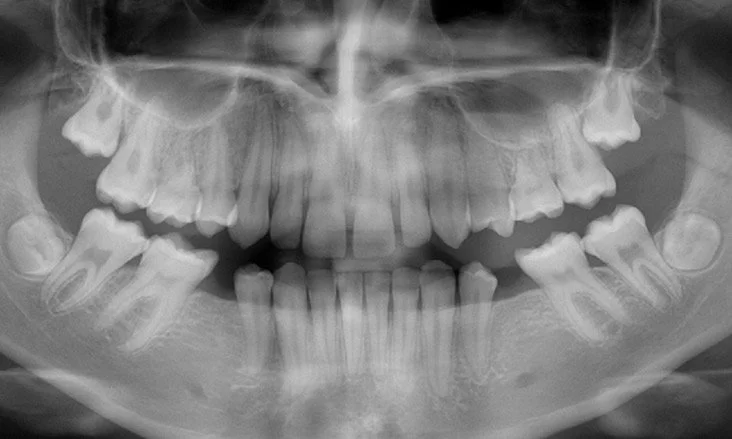
Missing premolars - courtesy of Platinum Orthodonticts
As for whether or not to space maintain for an early loss of an E with no sign of a successor, it is case dependent, and factors to consider include
Age,
Family history of missing teeth,
Llevel of development of their other premolars.
Status of other teeth
If all signs point towards the likelihood the premolar is actually missing, then you should not space maintain. If the patient is young you should warn the parent that there is a very small chance of the tooth still forming late, and that orthodontics could be required to re-open the space. Often orthodontics would be required to fully close the space in the case of a missing tooth anyway, so it’s good to prepare the family either way.
The priority is always a healthy mouth and dentition. So if an E needs to be extracted and no successor is noted, it should still be extracted. Inform the parent that they are likely to need future orthodontic treatment to manage the missing tooth options. If they are not close to their permanent dentition, you can warn the parent about alveolar ridge resorption, which can complicate future treatments. This is usually more a problem for the lower E’s than the upper E’s.
If the ridge becomes really thin before the patient has reached the permanent dentition, space closure may not be possible/is less predictable, and it can also complicate future implant placement. So even if we suspect a premolar is missing, we should still try to retain the deciduous tooth when possible, until they are ready for comprehensive orthodontics or until they’ve had an orthodontic opinion.
There are also nifty treatment options for missing 5’s such as molar auto-transplantation. So good planning is a must
Q: When is the best time to refer for an orthodontic assessment when you see that there is not enough room for permanent teeth to erupt (such as lack of space for a laterals or canines to come through)?
A: A good idea is to look at the level of root growth of the unerupted tooth. If there is little root growth, then even if there was space, it wouldn’t be erupting for quite some time, which would mean you would need to maintain that space for a long time. It would be better to wait until later when the root formation is such that the tooth will be ready to erupt as soon as the space has been created. In the meantime, the permanent tooth may still erupt in a rotated or buccal position, then it is easier for the orthodontist to bond to it and align it.
That being said, you don’t want to wait too late either as the tooth may lose its ability to spontaneously erupt. If they are getting older in relation to normal tooth eruption age, and the root is ¾ or more developed, and the partner tooth came through ages ago, then it’s probably not going to come through without the help of more space, whether that be from baby tooth extraction or creating space orthodontically.
Also, if there was a history of something that used to obstruct it, like a supernumerary tooth removed, that can often affect the tooth coming through of it’s own accord without assistance. So look at patient/tooth history, the length of the root, the adjacent teeth, the age, the space available, and all these factors help to decide when to intervene. If in doubt, always refer to the orthodontist earlier rather than later.
A tip as well. If you see the contralateral tooth has come down longer than 6 months ago, take a maxillary occlusal to assess for a supernumerary. If the lateral erupts before the central, there is definitely something up!
This concludes our orthodontic series. We hope that you have enjoyed it. As always if you have any suggestions for posts or questions, please email us at courses@kidsdentaltips.com.au
All the best
Tim, Sarah and Erica